Hooded Eyes: What Causes Them and How to Fix Them
By Dr. Sheila Nazarian, MD, board-certified plastic surgeon
By Dr. Sheila Nazarian, MD, board-certified plastic surgeon
Published
10 minute read
Last updated: November 2026
Hooded eyes are one of the most common concerns I see, and also one of the most misunderstood. A hooded eye is one where a fold of upper eyelid skin hangs down over the crease, sometimes resting close to the lash line. For many people it's simply their natural anatomy. For others it develops with age, and in some cases it starts to sit low enough to affect the edges of their vision. The right answer depends on which of those you're dealing with.
If hooding is cosmetic, non-surgical options soften it temporarily; if excess skin is heavy enough to affect your vision, upper eyelid surgery is what removes it.
These get mixed up, and they call for different plans. Hooded eyes are excess upper-eyelid skin folding over the crease. A monolid is a natural eyelid without a visible crease, which is an anatomical variation, not a problem to fix. A droopy eyelid, or ptosis, is when the lid margin itself sits low because the muscle that lifts the lid is weak or stretched. Ptosis repair is a separate procedure from removing excess skin, and part of a consultation is simply sorting out which one you have, since the surgery differs.
This is the first question worth answering, because it changes everything that follows.
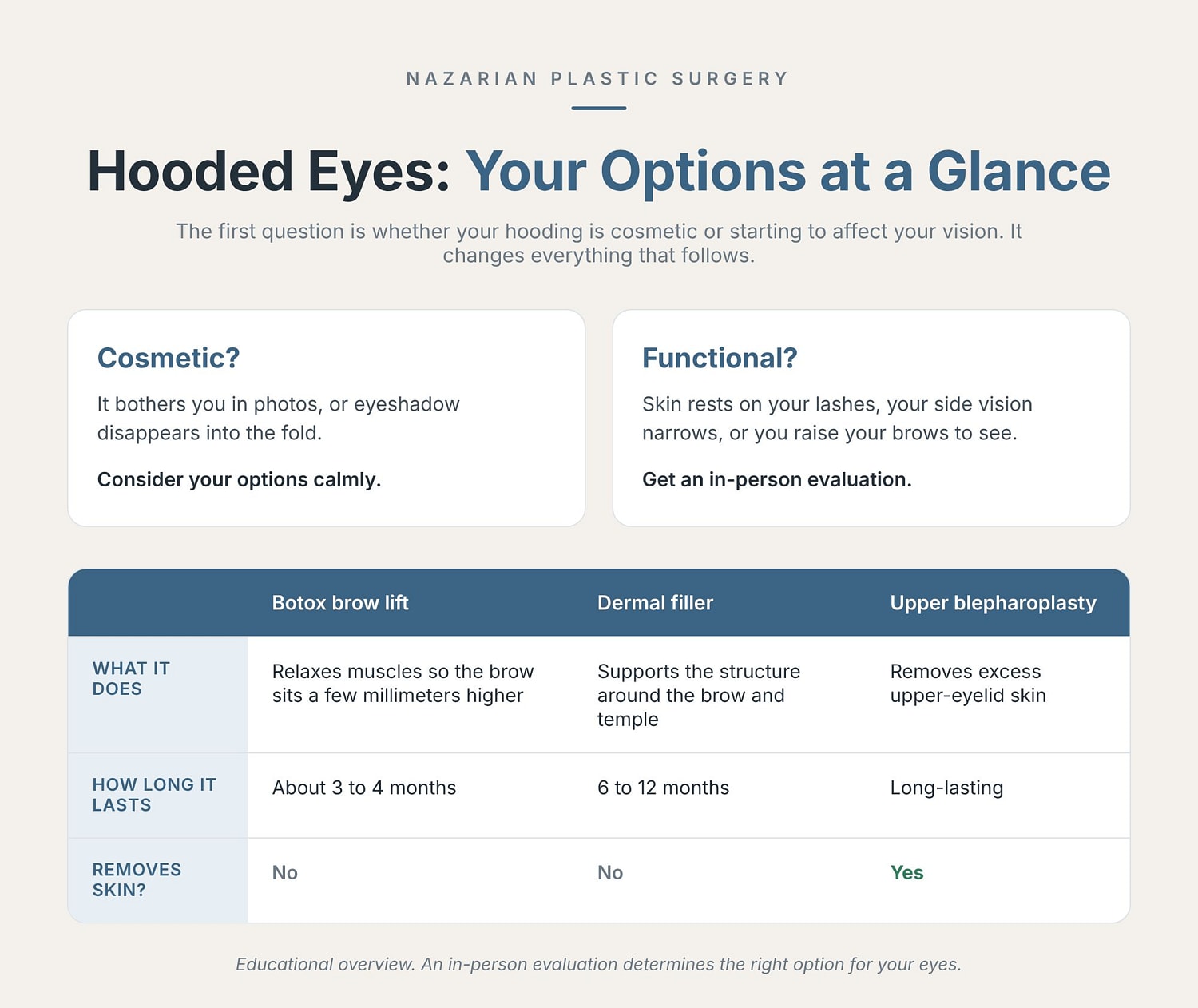
If your hooding bothers you in photos or makes eyeshadow disappear, that's a cosmetic concern, and you have time to weigh your options calmly. If you find yourself raising your brows to see better, your eyelids feel heavy by the end of the day, or your side vision seems narrower, the skin may have become what we call functional dermatochalasis. That deserves an in-person evaluation.
There are measurable thresholds used to define functional impairment. Commonly cited ones include a margin reflex distance (the gap from the pupil's light reflex to the upper lid margin) of 2 millimeters or less, and a superior visual field loss of at least 12 degrees or about 24 percent (Cahill et al., 2011). A visual-field test, done with the eyelids in their natural position and then again with the excess skin lifted, is how that loss is documented (Pemberton et al., 2018).
A few things combine to create the look.
The most common is dermatochalasis, the gradual loss of skin elasticity that lets the upper eyelid skin stretch and fold. Collagen and elastin decline with age, so skin that once sat crisply above the crease begins to drape over it. Alongside that, the brow itself can descend over time, which pushes more skin down onto the lid. Fat position and your individual bone and eyelid anatomy also play a part, which is why hooding looks different from one person to the next and why some people have it in their twenties while others never do.
Non-surgical treatments can soften mild hooding, and the effect is modest and doesn't last.
A Botox brow lift relaxes the muscles that pull the brow down, which lets the brow sit slightly higher and opens the eye a little. It's subtle and generally wears off in about three to four months. Strategically placed dermal filler at the brow or temple can restore a little support to the structure around the eye, and that generally lasts six to twelve months. Neither removes skin, so neither clears heavy hooding. There are also prescription eye drops (oxymetazoline) that lift a drooping lid margin by a small amount, but they treat a different problem, a drooping lid edge rather than excess skin, and they need daily use to keep any effect.
All three of these have their own risks, which I cover in the risks section below.
Curious whether a non-surgical approach suits your eyes? Book a consultation and we can look together.
When the skin itself is the problem, the treatment that removes it is upper blepharoplasty. I remove the excess upper-eyelid skin, and sometimes a small strip of muscle or a pocket of fat, through an incision hidden in the natural crease. When the brow has dropped and is adding to the heaviness, I may combine it with a brow lift so the result sits in balance.
For hooding that has become functional, the benefit is well documented. An American Academy of Ophthalmology assessment found that repairing upper eyelid dermatochalasis and ptosis significantly improves vision, peripheral vision, and quality of life (Cahill et al., 2011), and a later systematic review reached the same conclusion on both measured and patient-reported outcomes (Hollander et al., 2019). One useful detail for anyone with a borderline test: the improvement after surgery is often greater than the pre-operative field test predicts, so a borderline result doesn't necessarily rule out a meaningful benefit (Pemberton et al., 2018).
What surgery can't do is stop aging. It sets the clock back, and upper-eyelid results are generally long-lasting, with most people happy for many years.
Ready to find out whether surgery is right for you? Request a consultation at our Beverly Hills practice.
When hooding is cosmetic, it's an out-of-pocket procedure. When excess skin is blocking vision, some insurers cover upper blepharoplasty as a functional procedure, and the usual documentation is a visual-field test performed with the lids untaped and then taped, along with photographs and the measurements above. Coverage varies by insurer and is decided case by case, so I never promise it. To find out whether your hooding is likely to meet a functional threshold, schedule an evaluation and our team can walk you through the documentation and cost.
Every procedure here has real downsides, and you deserve to hear them before the upside.
For upper blepharoplasty, the risks include bruising and swelling, asymmetry between the two sides, visible scarring, temporary or longer-lasting dry eye, difficulty fully closing the eyes, infection, and bleeding. A 2023 systematic review and meta-analysis looked specifically at how different techniques affect the ocular surface and dry eye (Rodrigues et al., 2023). Very rarely, bleeding behind the eye can threaten vision and is treated as a surgical emergency. Most complications are uncommon and manageable, but they are real, and they are part of why this is a decision to make with a surgeon rather than online.
Non-surgical options are not risk-free either. A Botox brow lift can actually worsen hooding if the forehead muscle that helps hold the brow up is over-relaxed, which is one reason placement and dosing matter so much. Filler around the brow and temple carries a rare but serious risk of vascular complications, including, in very rare cases, vision loss if product enters a blood vessel. Even the prescription drops can cause eye irritation or redness and aren't right for everyone. These are reasons to have any of these done by an experienced, qualified medical provider.
We'll go through the risks that apply to your anatomy and your plan at your consultation.
Everyone heals at their own pace, and your exact timeline comes from your surgeon's aftercare plan. As a general guide for upper blepharoplasty:
This is general guidance and doesn't replace an in-person evaluation.
What causes hooded eyes? Most hooding comes from excess upper-eyelid skin as it loses elasticity with age, often combined with a brow that has descended over time. Your individual anatomy and fat position also play a part, which is why some people have hooded eyes young and others never do.
Can hooded eyes be fixed without surgery? Non-surgical options like a Botox brow lift or filler can soften mild hooding by lifting the brow slightly, but the effect is modest and temporary. They don't remove skin, so they can't clear heavy hooding.
Does blepharoplasty for hooded eyes improve vision? When excess skin has become heavy enough to block the top of your field of view, removing it through upper eyelid surgery improves vision, peripheral vision, and quality of life, which multiple reviews of functional cases have found. For purely cosmetic hooding, the benefit is in appearance rather than sight.
Will insurance cover eyelid surgery for hooded eyes? Sometimes, when the excess skin blocks vision and that is documented with a visual-field test done untaped and taped. Coverage varies by insurer and is decided case by case, so it can't be promised in advance.
How long is recovery from upper eyelid surgery? Bruising and swelling are most noticeable for the first one to two weeks, with most desk workers back after about a week. Residual swelling settles over the following weeks, and the final result settles over two to three months.
Are hooded eyes the same as droopy eyelids? Not quite. Hooded eyes are excess skin folding over the crease. A droopy eyelid, or ptosis, is when the lid margin itself sits low because of the muscle that lifts the lid. They can look similar and sometimes occur together, so an evaluation sorts out which one you have.
If hooded eyes are bothering you, or you're not sure whether yours are cosmetic or starting to affect your vision, book a consultation in Beverly Hills and we'll find the right approach for your eyes.
Cahill KV, Bradley EA, Meyer DR, Custer PL, Holck DE, Marcet MM, Mawn LA. Functional indications for upper eyelid ptosis and blepharoplasty surgery: a report by the American Academy of Ophthalmology. Ophthalmology. 2011;118(12):2510-2517. (Literature search conducted 2008.)
Hollander MHJ, Contini M, Pott JW, Vissink A, Schepers RH, Jansma J. Functional outcomes of upper eyelid blepharoplasty: a systematic review. Journal of Plastic, Reconstructive and Aesthetic Surgery. 2019;72(2):294-309.
Rodrigues C, Carvalho F, Marques M. Upper eyelid blepharoplasty: surgical techniques and results, a systematic review and meta-analysis. Aesthetic Plastic Surgery. 2023;47(5):1870-1883.
Pemberton JD, Salter M, Fay A, Thuro B, Spencer H, Dajani O. Investigation of Goldmann perimetry in evaluation of patients for upper eyelid blepharoplasty. Orbit. 2018;37(1):48-52.
Dr. Sheila Nazarian, MD, MMM, is a board-certified plastic and reconstructive surgeon in Beverly Hills and the founder of Nazarian Plastic Surgery. She trained in plastic surgery at the University of Southern California, where she serves as Assistant Professor in the Division of Plastic Surgery. She is also the star of the Emmy-nominated Netflix series Skin Decision: Before and After.